
A dramatic selloff swept through the global software sector this week, erasing more than $400 billion in market capitalization as investors grappled with the accelerating threat of advanced artificial intelligence tools directly challenging traditional enterprise software models.
The catalyst came from Anthropic, the San Francisco-based AI startup, which rolled out an expanded suite of agentic tools for its Claude platform — including industry-specific plugins under the "Cowork" umbrella. These enhancements enable AI agents to automate complex workflows in legal research, sales, finance, data analysis, marketing, and beyond, raising fresh concerns that legacy SaaS (software-as-a-service) subscriptions could face rapid obsolescence.
According to data compiled from Financial Modeling Prep and tracked by Axios, the software sector plunged approximately 25% over the past week. Broader estimates from Reuters indicate that software and services stocks shed nearly $830 billion in value over six trading days through early February, with some analyses placing cumulative 2026 losses closer to $1 trillion as the re-rating intensifies.
Hardest-hit names included legal and data powerhouses such as Thomson Reuters (down sharply amid fears for its Westlaw platform), LegalZoom (plunging nearly 20% on a single day), RELX (parent of LexisNexis), and enterprise giants like Salesforce, Workday, and Intuit. The S&P 500 Software & Services Index extended an eight-session losing streak, falling into bear market territory and registering its most oversold levels in decades.

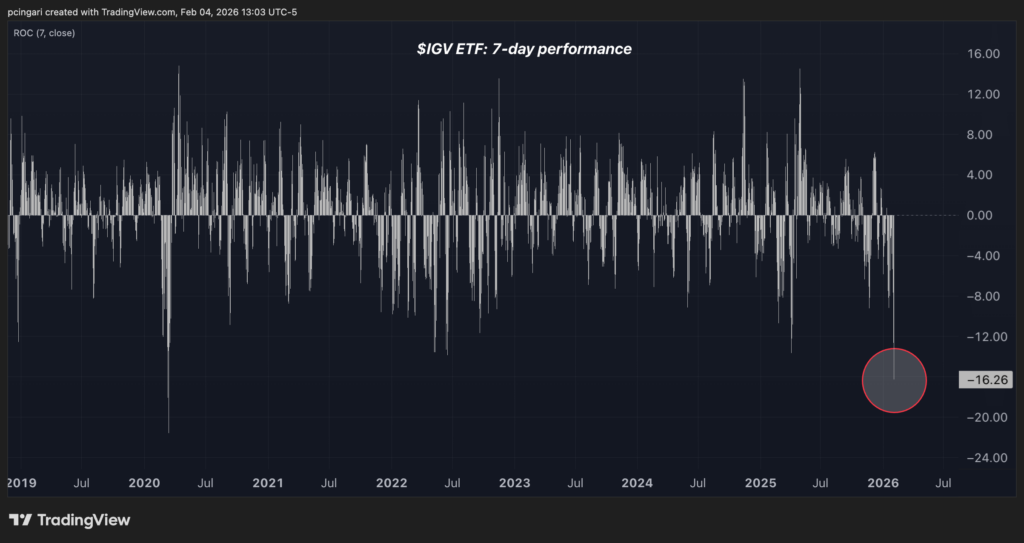
The selloff extended beyond pure software plays, dragging related sectors including financial services and asset management, with Bloomberg reporting a $285 billion rout on a single Tuesday session tied to Anthropic's announcements.
Market observers point to a shift in narrative: AI, long viewed as a tailwind for tech through massive infrastructure spending (with hyperscaler capex projected at $600–650 billion in 2026 alone), is now being priced as a disruptive force. Agentic AI — systems capable of autonomous, multi-step task execution — promises productivity gains of 40–70% in white-collar functions like coding, operations, and analysis, far exceeding earlier analyst models of 20–30%.
Hedge funds have aggressively positioned for the downturn, building short positions estimated at $20–25 billion in software names this year so far, according to CNBC reports. Trading floors buzz with reports of Fortune 500 companies quietly piloting full AI replacements for mid-tier CRM, ERP, and analytics stacks — shifts not yet visible in public earnings but fueling accelerated fear.


Anthropic's Claude, already a frontrunner in enterprise AI adoption, now stands at the center of the storm.


While some executives dismiss the reaction as overblown panic — arguing incumbents have time to integrate AI — quant models and analyst warnings suggest the pain may persist. If upcoming Q1 earnings reveal even modest deceleration in legacy subscriptions, vulnerable SaaS multiples could face another 15–30% leg lower, potentially pushing sector-wide losses toward the trillion-dollar mark by mid-2026.
This week's carnage marks more than a routine correction; it signals the market awakening to AI's dual nature — a creator of immense value for model-builders and infrastructure providers, yet a destroyer of entrenched software moats. As one trader put it: "The 'AI eats software' thesis just went from theory to pricing reality — and it's only getting started." Investors now watch closely for signs of whether this is a healthy re-rating or the opening act of a broader tech reckoning.


Comments