
Robert W. Baird lifts NVIDIA price target to $300 (Outperform) post-record Q4 earnings. Explore $68.1B revenue beat, Vera Rubin platform, consensus targets, risks & why NVDA remains the AI leader in 2026. for investors.
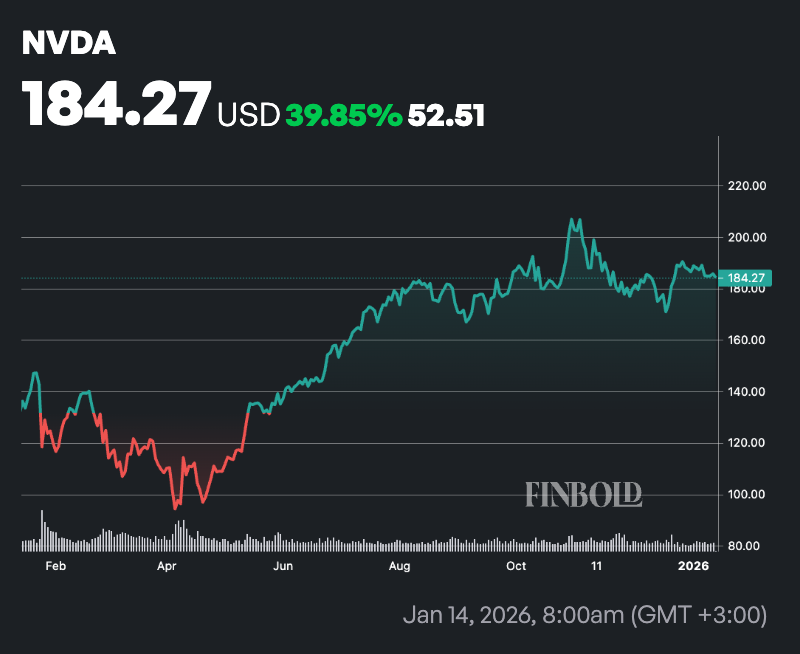 |
| AI predicts Nvidia stock price after Q4 earnings report |
Wall Street’s Bullish Bet on NVIDIA’s AI Supremacy
On February 26, 2026, Robert W. Baird raised its price objective on NVIDIA (NASDAQ: NVDA) from $275 to $300, maintaining an “Outperform” rating. The move implies approximately 53.3% upside from the stock’s previous close near $195.64.
This upgrade comes just one day after NVIDIA delivered blockbuster Q4 FY2026 results — $68.13 billion in revenue (up 73% year-over-year) and EPS of $1.62 that beat estimates. Data Center revenue alone hit $62.3 billion, underscoring the insatiable demand for AI accelerators.
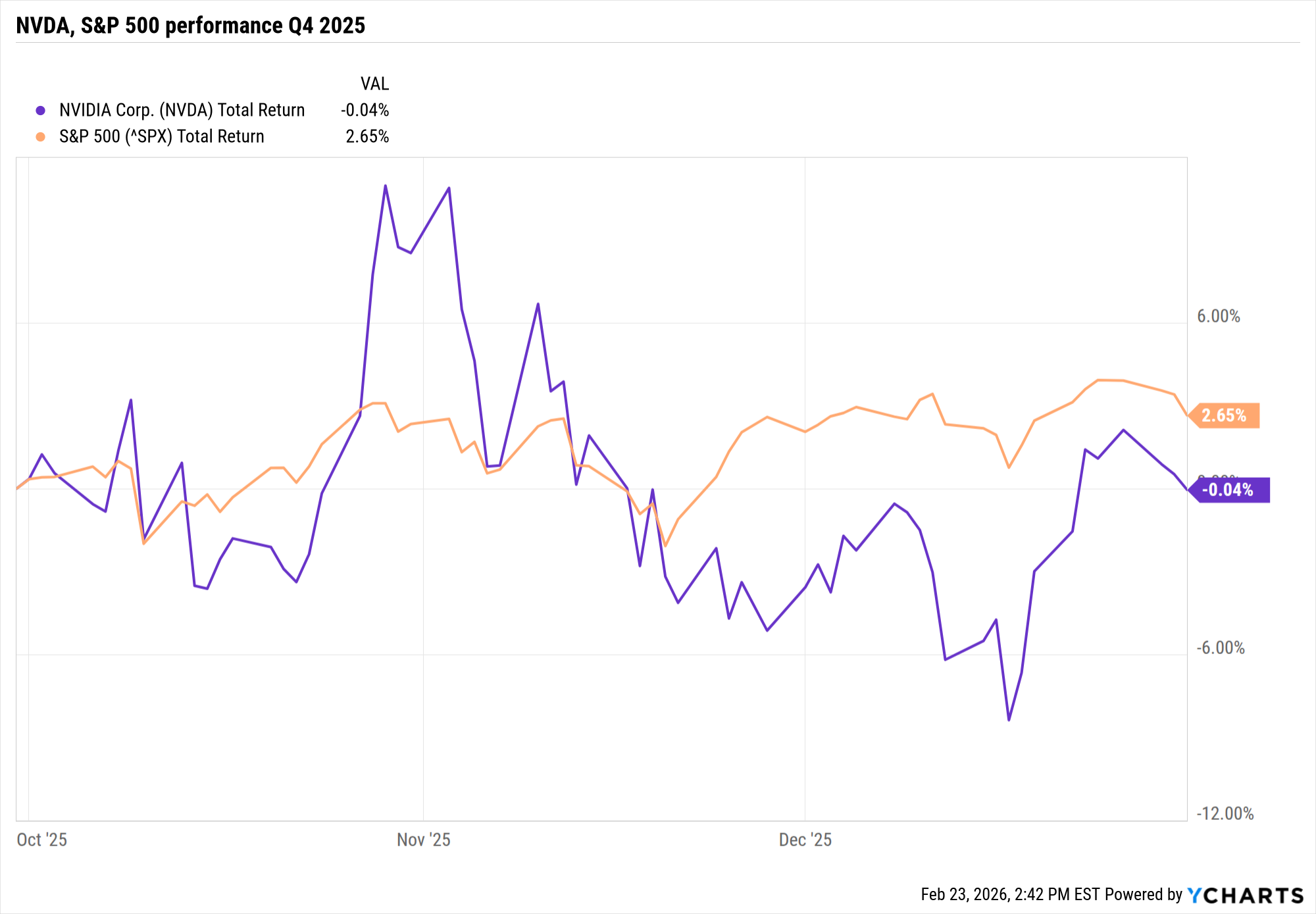 |
| NVDA vs S&P 500 performance chart Q4 2025–early 2026 (Kiplinger/YCharts) |
Nvidia Earnings: Live Updates and Commentary February 2026 |
Analysts across Wall Street are rushing to refresh models. Baird cites a “most predictable revenue path,” 80%+ modeled growth in data center revenue, sold-out supply, and the upcoming Vera Rubin (VR) platform’s potential to extend NVIDIA’s architectural lead.
Why Robert W. Baird Raised the Target: Key Drivers
Baird analyst Tristan Gerra (consistent top-ranked semiconductor voice) highlighted:
- Supply-constrained demand — Every major product is sold out through 2026.
- Predictable revenue visibility — Strongest in the industry.
- Vera Rubin/VR platform — Expected to deliver another generational leap in inference performance and power efficiency.
- 80% YoY data center growth modeled, with upside potential.
Other firms followed suit: Rosenblatt to $300 (Buy), Bernstein to $300 (Outperform), Truist to $283 (Buy), and Raymond James/Cantor maintaining elevated targets. Consensus across 47+ analysts remains Strong Buy with average 12-month target ~$258–$271 (MarketBeat/Zacks data), leaving room for further upward revisions.
NVIDIA’s Explosive Q4 FY2026 Earnings: By the Numbers
NVIDIA reported on February 25, 2026:
| Metric | Q4 FY26 Actual | Consensus Estimate | YoY Growth | Beat/Miss |
|---|---|---|---|---|
| Revenue | $68.13B | $65.56B | +73.2% | +$2.57B |
| Data Center Revenue | $62.3B | — | +75% | Record |
| GAAP EPS | $1.62 | $1.54 | +82% | +$0.08 |
| Gross Margin | ~75% (adj.) | — | Stable | Strong |
| Q1 FY27 Guidance | ~$78B | $72.6B | — | +$5.4B |
Full FY2026 revenue reached ~$215.9 billion (+65% YoY). Return on equity stands at 99.24%, net margin 53.01%. The company returned $41.1 billion to shareholders via buybacks and dividends in FY26, with $58.5 billion authorization remaining.
Jensen Huang, NVIDIA President & CEO, emphasized the shift to “agentic AI” and the Rubin platform: “We are at the beginning of a new industrial revolution… Rubin will deliver 10× inference performance at similar power.”
| NVIDIA CEO Jensen Huang presenting at a major tech event (Business Insider) |
How to Watch Nvidia's Jensen Huang Kick Off GPU Conference
NVIDIA’s Unmatched AI Moat: Blackwell, Rubin & Full-Stack Leadership
NVIDIA controls an estimated 80-90% share of AI training/inference accelerators. Key pillars:
- Blackwell (B200/GB200): Ramp accelerating; already two-thirds of Blackwell revenue in recent quarters.
- Vera Rubin (Rubin): Samples shipping now; full production H2 2026. Features 6-chip platform, HBM4 memory, 10× inference efficiency gains.
- CUDA Software Ecosystem: 4+ million developers; no viable alternative for full-stack AI deployment.
- Strategic Partnerships: Multi-year deals with Meta, Microsoft, AWS, Google, Oracle, and virtually every hyperscaler.
Market Context (Authoritative Sources)
- Deloitte (Feb 2026): Global semiconductor market to hit $975 billion in 2026, with generative AI chips alone approaching $500 billion (~50% of total).
- McKinsey: Semiconductor market could reach $1.6 trillion by 2030, led by leading-edge AI chips and HBM.
- NextMSC: AI chip market from $52.9B (2024) to $295.6B by 2030 (CAGR 33.2%).
NVIDIA is uniquely positioned to capture the lion’s share.
 |
| Stacked NVIDIA Blackwell/Rubin-class AI GPU modules (Kavout) |
What to Expect from Nvidia's GPU Technology Conference: A Deep Dive into Blackwell Ultra and the Upcoming Rubin GPU
Wall Street Consensus & Recent Analyst Actions (Table)
| Firm | Rating | New PT | Previous | Date (2026) |
|---|---|---|---|---|
| Robert W. Baird | Outperform | $300 | $275 | Feb 26 |
| Rosenblatt | Buy | $300 | — | Feb 26 |
| Bernstein | Outperform | $300 | $275 | Feb 26 |
| Truist | Buy | $283 | $275 | Feb 26 |
| HSBC | Buy | $310 | — | Feb 24 |
| Melius Research | Buy | $320 | $300 | Nov 2025 |
| Consensus (47 analysts) | Strong Buy | ~$258–$271 | — | Current |
(Data aggregated from MarketBeat, Investing.com, Zacks, TipRanks)
Valuation, Financial Health & Technical Snapshot
- Current Price (Feb 26 open): ~$195.64
- Market Cap: $4.75 trillion
- Trailing P/E: 48.55 | PEG Ratio: 0.58 (growth-adjusted attractive)
- Debt/Equity: 0.06 | Current Ratio: 4.47 (bullet-proof balance sheet)
- Insider Ownership: 4.17% | Institutional: 65.27%
Technical Levels
- 50-day MA: $186.30 | 200-day MA: $183.88 (stock well above both)
- 52-week range: $86.62 – $212.19
- Recent insider sales (Stevens, Puri) reflect routine diversification, not lack of confidence — total insider sales last 3 months $291M on a $4.75T company.
Balanced View: Key Risks Investors Must Weigh
No analysis is complete without risks (trustworthiness pillar):
- Valuation compression if AI capex slows.
- Competition — AMD MI355X, Google/Amazon custom ASICs, Meta’s large AMD order.
- Geopolitical — China export restrictions; management excluded China revenue from guidance.
- Supply chain — TSMC capacity constraints.
- Macro rotation — “AI fatigue” or higher rates.
Despite these, NVIDIA’s 99%+ ROE, 53% net margins, and sold-out backlog provide a high margin of safety.
Long-Term Outlook: 2026–2030 Bull Case
Baird and peers model continued 50–80% data center growth. If NVIDIA sustains 60–70% AI accelerator share in a $500B+ market, revenue could exceed $400–500B by FY2028–29. Multiple expansion to 55–60x forward earnings is plausible given PEG <1.0 and 40%+ EPS growth.
Base Case 12-Month Target Range: $280–$340 (aligns with new Baird $300). Bull Case (strong Rubin ramp): $400+ by end-2027.
FAQ – Frequently Asked Questions
Q1: What does the $300 price target mean for investors? Implied ~53% upside from current levels. Not a guarantee, but reflects analyst conviction post-earnings.
Q2: Is NVDA a buy right now? For long-term growth investors with 5+ year horizon and proper position sizing — yes. Short-term volatility expected.
Q3: How does Vera Rubin compare to Blackwell? Rubin targets 10× inference performance leap with next-gen HBM4 and new architecture.
Q4: What about competition from AMD or custom chips? NVIDIA’s CUDA moat and full-stack advantage keep it dominant; hyperscalers still allocate majority budgets to NVDA.
Q5: Impact of China restrictions? Excluded from guidance; management confident in US/rest-of-world demand.
Q6: Dividend & buyback outlook? Token dividend + aggressive $58.5B remaining authorization supports shareholder returns.
Q7: Valuation too high at 48x P/E? PEG 0.58 suggests undervalued on growth. Compare to historical leaders during platform shifts.
Conclusion: NVIDIA Remains the Premier AI Investment in 2026
Robert W. Baird’s upgrade to $300 reinforces the Street’s conviction: NVIDIA is not just riding the AI wave — it is the wave. With record earnings, sold-out supply, revolutionary Rubin architecture, and an unassailable software moat, NVDA continues to set the benchmark for tech growth stocks.
For long-term investors, NVIDIA belongs in core portfolios. For tactical traders, watch support near $180–$186 and resistance at $212–$225.
Important Disclaimer & Trustworthiness Statement This article is for informational and educational purposes only. It does not constitute financial, investment, or trading advice. Stock prices are volatile and past performance is no guarantee of future results. Always conduct your own due diligence and consult a qualified financial advisor before making investment decisions. The authors and publisher may hold positions in mentioned securities at any time. All data sourced from public, reputable platforms as of February 26, 2026.


Comments